
Incentive Travel and Employee Retention: The Strategic ROI of Extraordinary Experiences in 2026
Updated: Jul 20
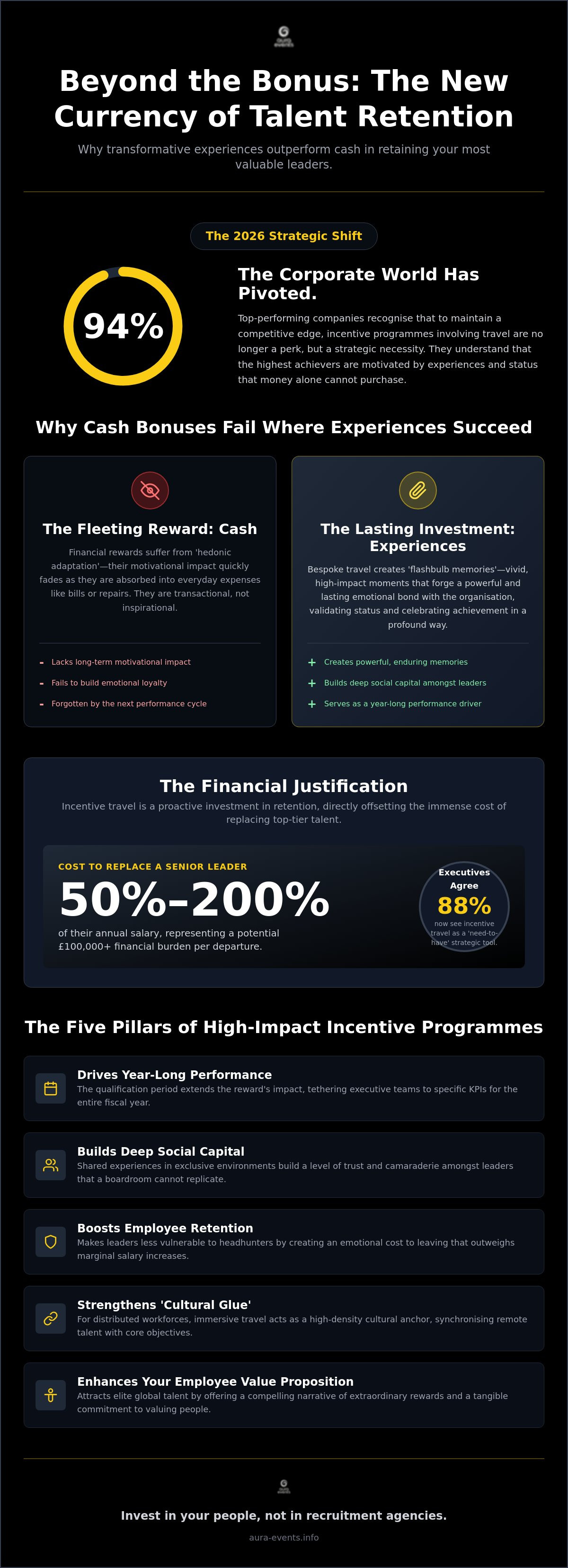
If a cash bonus is forgotten by the next tax cycle, why do we still rely on it to anchor our most valuable leaders? It's a question that many executive boards are starting to ask as the competition for high-level talent intensifies. You likely recognise the frustration of watching a key performer depart for a marginal salary increase, despite your significant investment in their growth. The link between incentive travel and employee retention isn't merely anecdotal. It's a strategic necessity in a landscape where 94% of top-performing companies now find these experiences essential for maintaining their edge.
We understand the scepticism often voiced by the finance department regarding luxury spend. However, bespoke travel serves as a critical lever for driving measurable business performance whilst fostering deep-rooted loyalty. This article provides a data-backed framework to justify your 2026 incentive budget. You'll gain insight into why your best people value transformative experiences over liquid assets. We'll also explore the practical criteria for selecting destinations that offer genuine "insider" access, ensuring your investment delivers a return that resonates long after the flight home.
Table of Contents
The Strategic Link Between Incentive Travel and Employee Retention
The corporate world is witnessing a fundamental pivot. By 2026, the era of passive, one-size-fits-all group tours has ended. It has been replaced by bespoke, transformative journeys that serve a specific purpose. We define incentive travel as a structured business strategy designed to drive specific high-performance behaviours. It isn't just a holiday. It's a calculated investment in human capital. For elite performers, the value lies in "social signalling." Being part of an exclusive cohort chosen for an extraordinary experience validates their status within the brand. Research from the Incentive Research Foundation confirms this shift; 94% of top-performing companies now find that a well-executed Incentive program involving travel is highly effective.
Hedonic Adaptation: Why Cash Bonuses Fail to Retain
Financial rewards are fleeting. They suffer from hedonic adaptation, a psychological process where the thrill of a pay rise or bonus evaporates as it's absorbed into daily life. Cash often pays for a new boiler or settles a credit card bill. These are necessary, but they don't inspire. The link between incentive travel and employee retention exists because travel creates "flashbulb memories." These sensory, high-impact moments trigger dopamine and forge a lasting emotional bond with the organisation. You don't remember the bank transfer. You remember the sunset over the Mediterranean from a private yacht.
Building Social Capital Amongst Leadership
Exclusivity is the new currency for elite performers. In 2026, top-tier talent seeks "insider access" that money alone cannot buy. This is where Aura Events excels, leveraging two decades of local expertise to open doors that remain closed to the public. Shared experiences in these hidden environments build social capital. When senior executives bond over a guided mountain activity in Chamonix or a private dinner in an Ibiza villa, they develop a level of trust that a boardroom cannot replicate. This collective memory acts as a shield. It makes your leaders less vulnerable to the siren call of headhunters, as the cost of leaving becomes an emotional loss, not just a financial one.
Measuring the ROI: Quantifying the Impact of High-End Retreats
Replacing a senior leader in the UK is a significant financial burden. It often costs between 50% and 200% of their annual salary when you factor in recruitment fees, lost momentum, and the price of onboarding. The math is stark. High-impact experiences serve as a preventative measure against these £100,000+ vacancy costs. Incentive travel and employee retention are now inextricably linked in the eyes of savvy directors who prefer to invest in their people rather than in recruitment agencies. For the modern, distributed workforce, incentive travel acts as a high-density 'cultural glue' that synchronises remote talent with core business objectives through immersive, face-to-face strategic alignment.
Your Employee Value Proposition (EVP) in 2026 must offer more than a competitive salary. It must offer a narrative. Top-tier global talent gravitates towards organisations that demonstrate a tangible commitment to extraordinary rewards. This isn't about vanity; it's about showing that you value the human behind the performance.
Performance and Goal Alignment
The 'qualification period' is a psychological masterstroke. It extends the impact of the reward across the entire fiscal year. Executive teams remain tethered to specific KPIs and long-term strategic growth, knowing that only consistent excellence secures their seat at an exclusive Ibiza villa or a Chamonix retreat. It transforms a one-off event into a twelve-month performance driver.
The Impact on Net Operating Income (NOI)
Sales productivity isn't the only metric that rises. Operational efficiency improves when leadership returns with renewed clarity. The Incentive Research Foundation 2023 report highlights a growing strategic emphasis on these programmes. Indeed, 88% of executives now categorise these experiences as a 'need to have' strategic investment. They understand that the cost of the trip is dwarfed by the value of a retained, high-performing team. If you are looking to quantify your own spend, exploring strategic offsite management can provide the clarity your CFO requires.
The 2026 Shift: Transformative Destinations and Insider Access
By 2026, the definition of luxury has matured. Standard five-star hospitality is no longer a differentiator; it is an expectation. High-performing executives now demand "insider access" to environments that feel authentic and unattainable to the general public. This shift is vital for incentive travel and employee retention because it transforms a reward into a narrative of belonging. When you provide access to a private estate or a hidden mountain refuge, you aren't just paying for a trip. You are inviting your leaders into an inner circle. Current incentive travel program research suggests that these immersive, exclusive elements are what truly cement long-term loyalty.
Wellness has also evolved beyond the hotel spa. It is now about "guided growth" and cognitive restoration. Leaders want to return from an offsite not just rested, but evolved. You can explore how these preferences are reshaping the market in our analysis of High-End Incentive Travel Trends 2026.
Ibiza: Repositioning for Strategic Vulnerability
Ibiza is often misunderstood by those outside the "inner circle." Beyond the neon, it offers a sanctuary for deep team bonding and strategic vulnerability. Secluded villas and private yacht charters provide the physical and psychological distance needed to strip away corporate personas. This environment fosters authentic connection, turning a leadership team into a unified force. For a detailed look at planning these high-impact sessions, see our guide to Luxury Corporate Retreats in Ibiza.
The Chamonix Effect: Alpine Clarity and Resilience
The French Alps offer a different, more rigorous energy. High-altitude environments naturally influence decision-making, forcing a focus on clarity and long-term resilience. Guided mountain activities aren't merely team building; they are exercises in trust and collective endurance. This "Chamonix Effect" is a powerful tool for aligning a board around a new vision whilst testing their resolve. Our guide on the Leadership Offsite Chamonix explores how to leverage this unique alpine energy for your strategy sessions.
Ready to design a programme that secures your top talent for the long term? You can start your bespoke journey here to discover venues that money alone cannot buy.
Orchestrating for Impact: The Case for Specialist Management
Logistical friction is the silent killer of corporate culture. When a high-performing executive encounters a travel delay or a subpar venue, the psychological impact of the reward is instantly diluted. It feels like a lack of care. This is why DIY planning is a high-stakes gamble that few organisations can afford. Specialist management ensures that every touchpoint follows a deliberate narrative arc. This journey begins with the first curated invitation and concludes with a transformative gala dinner. End-to-end management is essential for ensuring executive teams remain focused on strategy rather than logistics. The link between incentive travel and employee retention is only as strong as the execution of the experience itself.
At Aura Events, we leverage 20 years of local expertise to secure venues that money alone cannot buy. This "insider" advantage is what transforms a standard offsite into an extraordinary milestone, whether that is a private Mediterranean estate or an offshore adventure at Los Buzos. We understand that for an executive who has seen it all, the value lies in the unique, the hidden, and the perfectly executed.
Bespoke Itinerary Design and Theatre
We craft schedules that balance high-intensity strategy with restorative downtime. Sensory experiences are paramount. Private chefs and curated catering aren't just about sustenance; they create "theatre" and shared moments of connection. These moments ground the team in the present. We use our deep knowledge of Ibiza and Chamonix to source exclusive villas and private yacht charters—or partner with specialists like SailHamptons for US-based retreats—to provide the perfect stage for these interactions. Every detail is designed to foster a sense of belonging and prestige.
The Strategic Partner Model
Working with a boutique agency is a business necessity for ensuring a measurable return on investment. We act as a bridge between high-level corporate objectives and extraordinary, hidden environments. This model ensures that your retreat isn't just a holiday but a strategic tool. By aligning your business KPIs with a bespoke travel strategy, we help you build a culture that top-tier talent simply won't want to leave. It's about moving from a transaction to a transformation. This is how incentive travel and employee retention become a sustainable pillar of your growth strategy for 2026 and beyond.
Securing Your Leadership Legacy for 2026
The landscape of executive loyalty has shifted. It is no longer about the size of the year-end bonus but the depth of the shared experience. We've explored how bespoke travel acts as a psychological anchor, creating the social capital necessary to protect your most valuable human assets. By choosing destinations like Ibiza or Chamonix that offer genuine insider access, you move beyond the ordinary. You create a narrative of belonging that competitors simply cannot replicate. The strategic intersection of incentive travel and employee retention is where your long-term competitive advantage lives.
With over 20 years of bespoke event expertise, Aura Events provides the seamless end-to-end management required for global leadership teams. We offer exclusive insider access to private villas and mountain retreats, ensuring your strategic objectives are met whilst we handle the complexity of the logistics. It's time to transform your reward structure into a catalyst for growth. Elevate your next corporate retreat with Aura Events and ensure your top-tier talent remains exactly where they belong: at the heart of your organisation.
Frequently Asked Questions
How do you measure the ROI of an incentive travel programme?
You measure ROI by comparing the total cost of the programme against the saved costs of executive turnover and the incremental gain in KPI achievement. Replacing a senior leader in the UK often incurs costs between 50% and 200% of their annual salary. When you factor in recruitment fees and lost momentum, a well-executed retreat that retains just one or two key performers pays for itself. Tracking performance peaks during the qualification period provides additional data on productivity gains.
Is incentive travel more effective than a cash bonus for employee retention?
Yes, because travel creates a lasting emotional bond that cash cannot replicate. Financial rewards are quickly absorbed into daily life and often spent on mundane expenses like bills or home repairs. This is known as hedonic adaptation. In contrast, incentive travel and employee retention are linked through "flashbulb memories" and social signalling. An exclusive experience provides a sense of status and belonging that remains a powerful motivator long after a bank transfer is forgotten.
What are the top incentive travel destinations for 2026?
Ibiza and Chamonix are the definitive choices for 2026 because they offer the "insider access" that modern executives crave. Ibiza has successfully repositioned itself as a sanctuary for wellness and creative strategy sessions in secluded villas. Chamonix remains the benchmark for leadership resilience, using the alpine environment to foster high-altitude thinking. With 69% of buyers seeking new, immersive experiences, these locations provide the perfect balance of prestige and profound transformation.
How can incentive travel improve the performance of remote and hybrid teams?
Travel acts as a high-density "cultural glue" that synchronises remote talent with your core business objectives. For teams that rarely meet in person, a bespoke retreat provides the face-to-face interaction necessary to build deep-rooted trust. It moves beyond the limitations of digital communication, allowing for organic collaboration in a relaxed, high-end setting. This physical proximity is essential for aligning disparate teams with the company’s long-term vision and mission.
What is the role of 'insider access' in successful corporate retreats?
Insider access is the differentiator that elevates a retreat from a standard holiday to a strategic business tool. It involves securing private estates, yacht charters, or local experiences that are closed to the general public. This exclusivity makes your elite performers feel like part of an inner circle, which is a significant driver of loyalty. It’s about craftsmanship and local knowledge, ensuring that the reward feels as exceptional as the performance that earned it.


Comments