
Measuring Incentive Travel Success: A Strategic Framework for 2026
- 16 hours ago
- 8 min read
What if the true value of your £3,900-per-head leadership offsite isn't found in the invoice, but in the silence of a top performer ignoring a competitor's headhunt? It's a question that keeps many directors awake. You know that a week in the Ibizan hills or a retreat amongst the peaks of Chamonix transforms your team. Yet, when finance demands a cold justification for luxury spend, the soft benefits of culture and loyalty feel impossible to pin down.
Traditional incentive travel logistics management focuses on moving people and booking villas. It rarely touches the strategic pulse of the business. You deserve a better way to report success to the board. In this guide, we move beyond basic ROI to explore a sophisticated framework for 2026. We will show you how to quantify the profound cultural and financial impact of high-end corporate retreats. From tracking the Halo Effect on retention to aligning sensory experiences with strategic goals, you'll discover how to turn an exceptional journey into a measurable business asset.
Table of Contents
The Evolution of ROI: Why Traditional Metrics Fail Modern Leaders
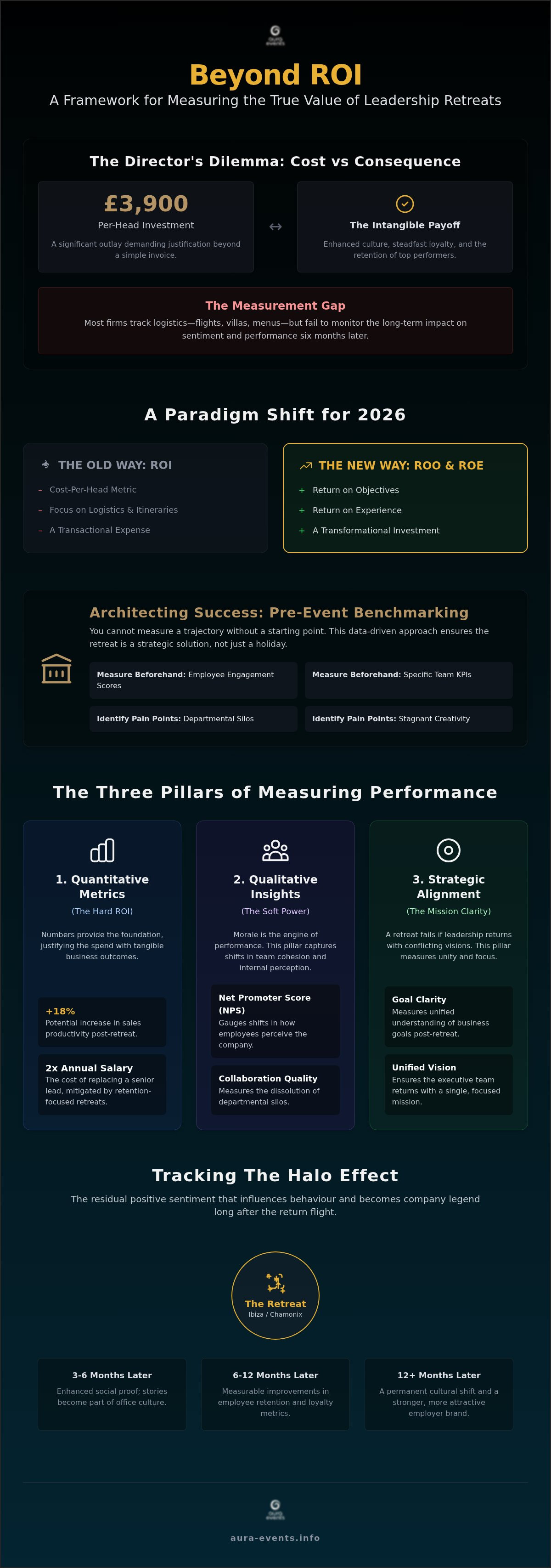
Traditional spreadsheets capture the cost but often miss the consequence. For decades, the industry relied on cost-per-head as the ultimate metric, treating people like line items. In 2026, the paradigm has shifted. Sophisticated leaders now prioritise Return on Objectives (ROO) over simple financial rebates. They understand that a sales bonus is merely a transaction, whilst a shared experience is a transformation. Truly understanding what is incentive travel in this new era requires looking past the itinerary to the strategic intent.
Most organisations fall into the Measurement Gap. They track the flights, the villas, and the menus, yet they fail to monitor the sentiment six months after the return flight. This is where standard incentive travel logistics management often falters. It organises the "now" but ignores the "next." Return on Experience (ROE) is the intersection of emotional impact and business output.
Beyond the Spreadsheet: The Psychological Value of Luxury
Luxury is a powerful psychological tool. It isn't just about soft linens or private chefs; it's about validation. When high-performers are granted exclusive access to hidden gems in Ibiza or private chalets in Chamonix, their sense of self-worth within the firm crystallises. These extraordinary environments strip away the mundane. They facilitate deeper strategic thinking that a boardroom simply cannot inspire. The result? Genuine loyalty that no competitor can easily buy.
Setting the Baseline: Pre-Event Benchmarking
You cannot measure a trajectory without a starting point. Effective benchmarking is the silent engine of a successful retreat. It involves measuring employee engagement scores and specific KPIs weeks before the group departs. By identifying current pain points, such as departmental silos or stagnant creativity, you can tailor the experience to be the solution. This data-driven approach ensures the retreat is a bridge to a better business state, not just a holiday on the company pound.
The Three Pillars of Measuring Incentive Performance
Success is a composite. It isn't found in a single data point but in the alignment of three distinct pillars. For the modern executive, measuring program effectiveness requires a lens that captures both the ledger and the spirit of the team. We move beyond the superficial to look at how hard data, soft sentiment, and strategic clarity intersect to create a high-performing culture.
Quantitative Metrics: The Hard ROI
Numbers provide the foundation. When calculating the value of a high-end retreat, compare the investment against the staggering cost of employee turnover. Replacing a senior lead often costs double their annual salary. A well-timed Chamonix leadership offsite acts as a retention anchor. Industry data suggests well-designed programmes can increase sales productivity by 18%. We track these spurts in the following quarter, looking for the tangible output that justifies the luxury spend.
Qualitative Insights: The Soft Power of Travel
Morale is the engine of performance. We use Net Promoter Scores (NPS) to gauge how internal perception shifts after an exclusive experience. Did the shared time in an Ibizan villa dissolve departmental silos? Qualitative data captures the quality of cross-departmental collaboration that spreadsheets ignore. This is where incentive travel logistics management evolves into a strategic tool. It ensures that the insider access we provide translates into genuine team cohesion.
The final pillar is Strategic Alignment. A retreat fails if the leadership returns with conflicting visions. We measure the clarity of business goals amongst the executive team post-retreat to ensure the mission is unified. Success occurs when all three pillars integrate. Hard data justifies the spend, whilst qualitative sentiment and strategic clarity prove the long-term transformation. If you are ready to move beyond basic tracking, consider how bespoke performance-focused itineraries can sharpen your firm’s competitive edge.
Tracking the Halo Effect: Long-Term Impact on Culture
The impact of a retreat shouldn't end at the arrivals gate. The Halo Effect is the residual positive sentiment that influences employee behaviour for months. It's the difference between a fleeting perk and a permanent cultural shift. When expert incentive travel logistics management is applied, it creates lasting legends. A private yacht charter in Ibiza isn't just a day on the water. It's a story that lives in the office for years.
Standard agencies often view these trips as a one-off expense. We see them as an investment in social proof. When your top performers recount their bespoke mountain activities, they aren't just celebrating. They are building your employer brand. This organic advocacy makes recruitment easier, as high-tier talent seeks firms that invest in genuine human transformation. It moves the conversation from "what is the salary?" to "what is the culture?".
The 90-Day Review: Sustaining the Momentum
The most critical data point often arrives three months after the team returns. This is when the initial "holiday high" fades, leaving behind the true structural changes. We focus on methods for keeping retreat-born initiatives alive in the daily workspace. Are teams still collaborating across the silos that were broken down in the Alps? Effective incentive travel logistics management ensures this momentum doesn't stall, making it essential for modern high end incentive travel.
Destination-Specific Impact: Chamonix vs Ibiza
Environment dictates outcome. Chamonix, with its rugged peaks, fosters a spirit of resilience and "grit" perfect for high-stakes strategic planning. Conversely, the Mediterranean light of Ibiza encourages creative expansion and human connection. Selecting the right backdrop is a psychological decision. It's about matching the environment to the specific behavioural changes you wish to see. If you are ready to design a legacy, view our Ibiza and Chamonix portfolio to find your perfect setting.
Architecting Success: Integrating Measurement into the Design Phase
Measurement is not a post-event autopsy. It is a blueprint. In 2026, the most effective retreats are those where data collection is woven into the very fabric of the itinerary. At Aura Events, we use our two decades of local expertise to ensure that luxury villa sourcing is never just about the aesthetic. It is about aligning the physical environment with your precise meeting requirements and cultural goals. True incentive travel logistics management requires this level of foresight, where every logistical choice, from private transport to wellness programmes, serves a specific strategic objective.
Bespoke Itineraries as Data Collection Tools
We view every activity as a live laboratory for business behaviour. A guided mountain activity during a leadership offsite Chamonix reveals more about team dynamics and resilience than any boardroom workshop. Similarly, curated dining experiences with private chefs provide structured windows for feedback and strategic alignment. By architecting these moments with intent, we transform a high-end escape into a powerful diagnostic tool for your organisation.
The Aura Events Approach to Reporting
The transition from a simple vendor to a strategic partner relies on absolute data integrity. Our end-to-end management model ensures that no insight is lost in translation between the mountain and the boardroom. A dedicated project manager acts as an on-site observer, capturing the subtle shifts in morale and leadership clarity that standard agency reporting often misses. We provide the board with a comprehensive narrative of success, grounded in real-time insights and long-term KPIs. This methodical approach ensures that your investment in Ibiza or Chamonix delivers a clear, documented path to improved business performance.
Transforming Experience into Strategic Equity
The board no longer accepts vague reports of "good vibes" from the Mediterranean. In 2026, the shift from simple cost-tracking to sophisticated Return on Experience is absolute. By integrating measurement into the design phase and tracking the long-term Halo Effect, you transform a luxury getaway into a strategic business asset. Success is found in the intersection of hard performance data and the qualitative stories that define your culture for months after the return flight.
Superior incentive travel logistics management demands more than just booking flights. It requires a partner who understands the psychological weight of an Ibizan sunset or a Chamonix mountain trail. With over 20 years of specialist expertise, Aura Events provides end-to-end luxury management, from bespoke villa sourcing to on-site execution. We ensure that every detail of your high-performance leadership itinerary serves a documented purpose.
Discover how Aura Events designs retreats that deliver measurable business results. Your team’s next transformation is waiting amongst the peaks or by the shore.
Frequently Asked Questions
What is the most important KPI for measuring incentive travel success?
The most critical KPI is the Return on Objectives (ROO), as it measures whether the retreat solved specific business pain points. Whilst sales targets are vital, modern leaders prioritising incentive travel logistics management focus on employee retention rates. If a top performer remains for an extra year following an offsite, the saved recruitment costs often exceed the initial investment, making longevity a primary indicator of genuine strategic success.
How do you calculate the ROI of a luxury corporate retreat?
You calculate ROI by comparing the total investment against the financial gains from increased productivity and reduced staff turnover. For example, replacing a senior executive in London often costs up to 200% of their annual salary. If a bespoke Chamonix retreat prevents just one departure, the ROI is immediate. We analyse performance data from the quarter following the event to track tangible output spurts and efficiency gains.
Can you measure the cultural impact of a trip to Ibiza or Chamonix?
Cultural impact is measured through Net Promoter Scores (NPS) and qualitative sentiment analysis. We track shifts in brand perception and internal morale before and after the experience. In destinations like Ibiza, we specifically monitor the quality of cross-departmental collaboration. If departments that previously worked in silos begin co-authoring projects, the "Halo Effect" of the shared experience is successfully driving a more integrated and high-performing corporate culture.
How soon after the event should we conduct a success survey?
You should distribute an initial survey within 48 hours to capture the immediate emotional impact and logistical feedback. However, the most valuable data emerges during a 90-day review. This delayed assessment measures how retreat-born initiatives have integrated into daily office life. Effective incentive travel logistics management ensures that momentum is sustained, allowing you to see if the strategic clarity achieved in the Alps remains after three months.
What is the difference between ROO and ROI in event planning?
ROI focuses on the financial return in pounds and pence, whilst ROO measures the achievement of specific strategic goals. ROI asks if the trip paid for itself through sales. ROO asks if the leadership team is more aligned or if employee loyalty has deepened. Both are essential for a holistic view. ROI justifies the spend to finance departments, whereas ROO proves the long-term cultural transformation to the board.


Comments