
Presenting Incentive Travel ROI to the Board: The 2026 Executive Guide
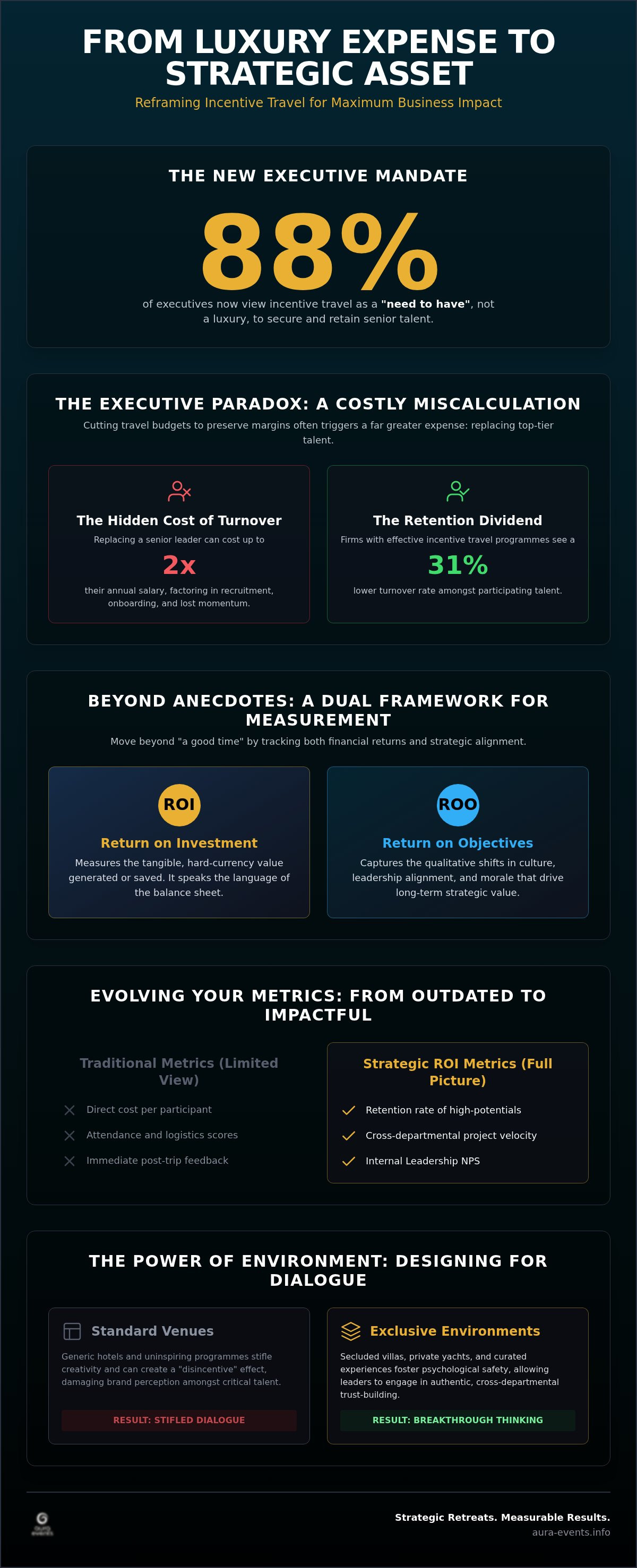
What if the most significant risk to your 2026 growth isn't market volatility, but the quiet departure of your most senior talent? With 88% of executives now viewing incentive travel as a "need to have" rather than a luxury, the traditional perception of retreats as mere holidays has become a dangerous liability. You know that culture drives performance, yet you likely struggle when presenting incentive travel ROI to the board. It's difficult to quantify the value of a shared experience in Ibiza or a summit in Chamonix when faced with a room of pragmatists.
We understand the pressure to turn "soft" benefits into hard data. This guide will show you how to reframe high-end retreats as measurable drivers of retention and business ambition. You'll learn a robust framework for measuring Return on Objectives (ROO) alongside traditional ROI. We'll also explore how a strategic partner like Aura Events transforms these luxury experiences into sophisticated business tools, ensuring every pound spent serves a specific corporate goal.
Table of Contents
Redefining Incentive Travel ROI: From Luxury Expense to Strategic Asset
A corporate retreat is often viewed through a narrow lens of indulgence. To the board, it might look like a "jolly" on the company ledger. This perception is outdated. When presenting incentive travel ROI to the board, the narrative must pivot from discretionary spending to capital investment. In 2026, high-impact retreats are strategic environments designed to protect senior leadership stability and foster profound human connection.
An "Executive Paradox" is currently reshaping the UK corporate landscape. Firms often cut travel budgets to preserve margins, yet they inadvertently trigger higher talent replacement costs. Replacing a senior leader often costs up to twice their annual salary when you account for lost momentum and headhunter fees. Data from July 2026 confirms that companies with effective Incentive travel programs experience a 31% lower turnover rate amongst participants. For the board, a well-executed retreat is a signal of stability and ambition in a competitive global market.
The Hidden Cost of 'Standard' Corporate Travel
Generic programmes fail because they lack the exclusivity senior talent expects. A stay in a standard hotel doesn't inspire breakthrough thinking; it suggests a lack of corporate vision. Logistical friction or uninspiring venues create a "disincentive" effect that damages brand perception amongst your most critical people. True exclusivity fosters psychological safety. It allows leaders to drop their guard and engage in the cross-departmental trust-building that drives business performance.
Reframing the Narrative for the CFO
The conversation must move from "price per person" to "impact per business objective." CFOs respond to strategic utility, not just anecdotes of team bonding. By utilising high-end incentive travel as a tool for talent development, you demonstrate a commitment to the firm's longevity. When presenting incentive travel ROI to the board, frame the retreat as a catalyst for project velocity and a safeguard for institutional knowledge.
Measuring the Unmeasurable: A Framework for Quantifying Retreat Success
Numbers tell a story, but only if you know which ones to track. When presenting incentive travel ROI to the board, anecdotal evidence of a "good time" is insufficient. You must speak the language of the balance sheet. This requires a shift from viewing a retreat as a singular event to seeing it as a measurable business intervention. Establishing baseline KPIs before the aircraft leaves the tarmac is essential. Whether it is employee engagement scores or departmental project velocity, you need a pre-event benchmark to prove the post-event uplift.
We utilise a sophisticated framework for quantifying success that distinguishes between financial Return on Investment (ROI) and strategic Return on Objectives (ROO). ROI measures the hard currency saved or earned. ROO, however, captures the qualitative shifts in culture and leadership alignment that drive long-term value. By implementing post-event feedback loops 30, 90, and 180 days after the retreat, you can track how these strategic shifts settle into the firm's daily operations.
Tangible vs. Strategic ROI Metrics
The board needs to see how soft benefits translate into hard assets. Use this comparison to illustrate the depth of your measurement strategy:
Discussing your specific KPIs with a strategic retreat consultant can help align your itinerary with these measurable outcomes, ensuring the data supports your narrative.
The Retention Multiplier Explained
The cost of losing a C-suite executive or a high-performing director is staggering. In the UK, replacing a senior leader often costs twice their annual salary when factoring in search fees, onboarding, and lost institutional momentum. Contrast this with the strategic investment in a luxury corporate retreat in Ibiza. The Retention Multiplier is the ratio of retreat cost to saved recruitment fees. By monitoring the flight risk of key attendees 12 months post-retreat, you can present a clear financial win to the CFO that far outweighs the initial spend.
Designing for Maximum Yield: The Anatomy of a High-Impact Itinerary
The physical environment dictates the quality of the strategic output. A boardroom, whilst functional, often carries the weight of past conflicts and rigid hierarchies. In contrast, a secluded luxury villa or a private yacht charter removes these invisible barriers. This is a critical point when presenting incentive travel ROI to the board. You aren't just buying a view; you're purchasing the psychological openness required for breakthrough thinking. Authentic dialogue happens when leaders feel secure, valued, and physically removed from the daily grind.
Alignment is everything. Destination choice must mirror your business objectives. Ibiza serves as a high-energy catalyst for innovation and creative disruption. Conversely, Chamonix offers the serene focus required for complex alpine strategy and long-term planning. To ensure your next itinerary is engineered for maximum yield, contact our team to design a bespoke strategic retreat.
The 5 Steps to an ROI-Focused Itinerary
Step 1: Identify the 'Core Friction'. Pinpoint the specific business problem the retreat must solve, such as departmental silos or stagnant innovation.
Step 2: Select the Catalyst. Choose the environment that matches the goal, whether it is the vibrancy of the Mediterranean or the focus of a leadership offsite in Chamonix.
Step 3: Curate Bespoke Activities. Design challenges that reflect the brand's sophisticated values whilst pushing leadership boundaries.
Step 4: Balance Output. Interleave 'High-Octane' team challenges with 'Deep Work' sessions to ensure cognitive output matches the financial input.
Step 5: Leverage Insider Access. Utilise local expertise to provide exclusive experiences that make employees feel uniquely valued by the organisation.
Strategic Downtime: Where the Real ROI Happens
True breakthroughs rarely happen at 2 PM during a PowerPoint presentation. They happen during "unstructured luxury." A sunset cruise on a private yacht facilitates natural networking that a formal agenda simply cannot replicate. Without the constraints of a ticking clock, senior leaders find the space to discuss legacy, culture, and long-term ambition. This is where the real Return on Objectives is secured. It is the quiet moments between the mountain hikes and the private chef dinners that often yield the most significant business pivots.
Protecting the Investment: The Value of Local Expertise in Ibiza and Chamonix
Strategic planning is only as robust as its execution. When presenting incentive travel ROI to the board, you must address the "execution gap" that often swallows corporate budgets. A failure in logistics isn't just a nuisance; it's a direct threat to the financial investment. DIY planning often hides costs like inflated vendor markups and the missed opportunity of uninspiring, standard venues. These hidden frictions can quickly turn a strategic retreat into a costly administrative burden.
Twenty years of local presence in Ibiza and Chamonix allows us to act as a strategic filter. We mitigate operational risk by selecting only partners and venues that meet the most exacting executive standards. Professional management isn't a luxury add-on. It's the ultimate insurance for your company's ROI, ensuring that the environment facilitates, rather than hinders, your business goals.
Insider Access as a Force Multiplier
True exclusivity isn't found on a public booking platform. We source private villas and alpine chalets that remain hidden from the general market, providing a level of privacy that encourages candid leadership dialogue. Our long-standing relationships provide a level of negotiating authority that prevents budget creep and ensures priority service. This ensures every pound spent contributes to the strategic goal rather than being lost to the inefficiencies of a standard travel agency.
The Aura Events Difference
Our commitment to end-to-end management covers every detail, from initial villa sourcing to ground logistics and private chef services. We don't just book trips; we architect environments for performance. Aura Events' approach represents the intersection of luxury hospitality and corporate performance strategy. By handling the ground transportation and mountain activities with precision, we free your leadership team to focus on the high-level objectives that drive the firm's 2026 growth. To secure your investment and ensure a seamless execution, partner with a strategic retreat expert today.
Securing Boardroom Approval for Your Leadership Strategy
The transition from a discretionary spend to a strategic investment requires a shift in perspective. By reframing high-end retreats as tools for talent retention and cross-departmental trust, you provide the board with a narrative rooted in business performance. Success lies in the precision of the measurement and the exclusivity of the environment. Whether it's the focused alpine air of Chamonix or the creative energy of Ibiza, your choice of destination must serve a specific corporate objective.
When presenting incentive travel ROI to the board, the most persuasive argument is a risk-free execution. Partnering with a specialist ensures that your vision is grounded in operational excellence. With 20 years of specialist expertise in Ibiza and Chamonix, we provide insider access to exclusive, off-market locations that public platforms cannot reach. Our bespoke management is focused entirely on strategic business outcomes, turning luxury into a force multiplier for your organisation.
Design your high-impact corporate retreat with Aura Events and transform your next leadership summit into a measurable driver of success. It's time to elevate your corporate ambition.
Frequently Asked Questions
How do you calculate the ROI of an incentive travel programme?
You calculate ROI by subtracting the total programme cost from the net profit generated by the participating team, then dividing by that same cost. When presenting incentive travel ROI to the board, focus on tangible metrics like the 18% increase in sales productivity typically reported after such interventions. It's essential to account for all variables, including private transport and catering, to provide a transparent and defensible financial model.
What is a realistic ROI for a corporate retreat in 2026?
A well-structured incentive travel programme in 2026 can deliver a return on investment of 112%. This figure is achievable for organisations that move beyond generic travel and align their itineraries with specific strategic goals. To reach this level of yield, the retreat must be engineered to facilitate breakthrough thinking. This ensures the cognitive output of your leadership team far outweighs the initial capital expenditure.
Can high-end incentive travel really improve employee retention?
Yes, research from July 2026 shows that companies with effective incentive programmes experience a 31% lower turnover rate amongst participants. High-end retreats function as a powerful "Retention Multiplier" by fostering deep human connection and loyalty. By reducing senior talent flight risk, you protect the firm from the staggering costs of headhunter fees and the loss of critical institutional knowledge.
What is the difference between ROI and ROO in event planning?
ROI measures hard financial gain, whilst Return on Objectives (ROO) quantifies the achievement of strategic goals such as improved leadership alignment or psychological safety. Both metrics are indispensable when presenting incentive travel ROI to the board. Whilst ROI addresses the CFO's bottom-line concerns, ROO demonstrates how the retreat has successfully resolved internal frictions that might otherwise stifle the company's 2026 growth trajectory.
How does destination choice affect the return on investment?
The destination serves as the psychological catalyst for the retreat's success. Choosing Ibiza might drive high-energy innovation and creative disruption, whereas Chamonix offers the serene environment necessary for focused alpine strategy. A destination that clashes with your business objectives will inevitably lower your return. The environment must be selected with the same analytical rigour as any other business tool to ensure maximum strategic impact.


Comments