
Leadership Retreat Agenda: Goals, People and Purpose
A leadership retreat isn’t simply a meeting in a different setting. A well-designed leadership retreat agenda gives a team space to address shared priorities, strengthen working relationships and reconnect with the purpose behind its work. These gatherings are often held offsite, typically last at least a day and bring together a small group of colleagues whose work is closely connected.
The people in the room matter as much as the schedule. A retreat for senior leaders may focus on strategic direction, while one for a wider leadership group may clarify responsibilities and improve collaboration. Trying to fit every organisational challenge into the agenda can leave little room for meaningful discussion. This guide explains who leadership retreats serve and how clear objectives shape the programme, with practical ways to make space for reflection, inclusive participation and shared direction.
Table of Contents
1. What Is a Leadership Retreat?
A leadership retreat brings colleagues with interrelated responsibilities together away from routine workplace demands. These groups often include 8 to 25 people, such as peers reporting to the same leader. An offsite setting can create space for creative thinking, focused learning and conversations that ordinary meetings rarely allow.
A strong leadership retreat agenda connects clear objectives with strategic discussion, reflection, breaks and shared activities. It should also make time to consider how leaders work together, explore organisational culture and develop a shared vision. Team-building is most effective when activities suit participants’ interests and abilities, rather than relying on a one-size-fits-all challenge.
Leadership retreats typically last at least one day and take place offsite. A one-day programme can move from priorities and discussion in the morning to team reflection, practical planning and a closing review in the afternoon. Scheduled breaks help sustain productive conversation; an informal meal can create room for social connection.
A two-day programme gives the group more time to build trust and turn learning into action. Day one might focus on alignment and shared challenges, followed by an evening meal. Day two can centre on decisions and action planning. A reflective walk or another quiet activity can offer a change of pace from formal sessions.
For an offsite in the UK, choose a venue with meeting space, reliable Wi-Fi and rooms or areas for breakout discussions. Check that the setting supports the planned activities and that food, drink and basic meeting materials are arranged. Consider travel and access needs early, since difficult journeys or unsuitable room layouts can limit participation.
Common planning mistakes include overloading the schedule, choosing activities that exclude participants and leaving too little time for breaks or decisions. Vary the session formats and make sure activities suit the group. Reserve time to assign owners, resources and timelines to agreed actions, so the retreat ends with a practical plan as well as good conversation.
2. Inclusive participation and facilitation
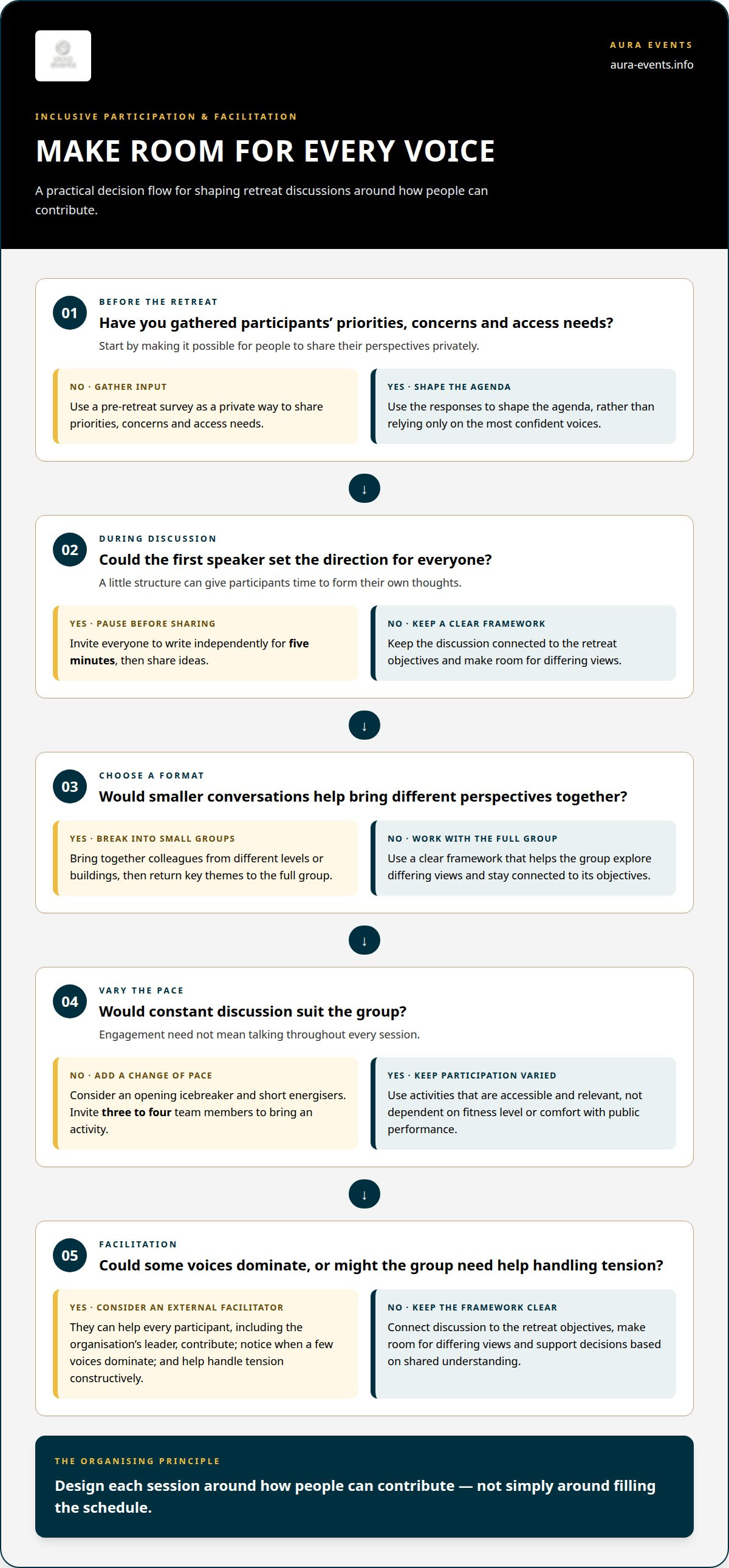
Inclusive participation starts before the retreat. A pre-retreat survey gives participants a private way to share priorities, concerns and access needs. Use their responses to shape the agenda, rather than relying only on the most confident voices. This also helps everyone arrive with a clearer sense of the retreat’s purpose.
During a discussion, structure matters. The facilitator might invite everyone to write independently for five minutes before sharing ideas. That pause gives quieter members time to form their thoughts and prevents the first speaker from setting the entire direction. Small-group conversations can then bring together colleagues from different levels or buildings, before key themes return to the full group.
Engagement needn’t mean constant discussion. An opening icebreaker can establish a welcoming tone, whilst short energisers create a change of pace. Organisers can invite three to four team members to bring an energiser activity, giving participants a role in shaping the experience. Activities should be accessible and relevant, not dependent on a particular fitness level or comfort with public performance.
An external facilitator can help every participant, including the organisation’s leader, contribute. A clear framework keeps discussion connected to the retreat objectives, makes room for differing views and helps the group handle tension constructively. A facilitator can also notice when a few voices dominate and invite other perspectives without putting anyone on the spot. This supports a more balanced conversation and decisions based on shared understanding.
For a retreat where participation and the setting work together, thoughtful leadership retreat planning can bring the experience into focus. The value lies in designing each session around how people can contribute, not simply filling the schedule.
3. Reconnecting leaders with their personal purpose
A purpose exercise gives leadership teams space to examine what drives their work, beyond targets and job titles. One practical format takes 25 minutes. The facilitator can invite each manager to consider a moment when their contribution felt especially valuable, then identify the values and skills involved. A specific memory often reveals more than an abstract prompt.
Make the reflection structured, but personal. In one suggested activity, the first five minutes are spent watching part of Simon Sinek’s TED Talk. Participants then write independently before discussing their reasons for doing the work in groups of two to three. This sequence gives each person time to find their own words before hearing colleagues’ perspectives.
Purpose becomes useful when it connects to working relationships and everyday choices. One leader might recognise that developing team members matters more than owning every decision; another may see clear communication as central to their contribution. Sharing these insights helps colleagues understand one another’s motivations, identify common values and consider how their strengths can complement each other.
The aim is not a polished statement for display, but a clearer link between personal motivation and shared success. Leaders at each Future Ready Institute have spent time reflecting on personal purpose and what drives their work for the past two years. A retreat can turn similar reflection into a practical discussion: where do individual motivations support the team’s direction, and where might expectations need to change?
Close the exercise with one concrete commitment from each participant. A manager might agree to make more room for a colleague’s expertise or explain the reasoning behind a difficult decision. These actions bring purpose into everyday working relationships, rather than leaving it as an inspiring moment that fades after the retreat.
4. Leadership retreat goals and audience types
Start with one organisational milestone, not a catalogue of challenges. Your leadership team might need to prepare for a strategic shift, improve cross-functional decisions or clarify its vision for the next few years. That focus creates room for long-term thinking while keeping discussion connected to real choices.
Audience shapes the work. A senior executive group can focus on strategic direction and trade-offs; functional leaders may need to connect priorities across departments. A newly formed leadership team might concentrate on roles, decision-making and shared expectations. An all-hands development day for 250-750 attendees serves a different purpose, requiring a broader format than an intimate retreat.
Choose topics that directly support the intended outcome. If the goal is innovation, sessions could examine barriers to experimentation and identify where teams can test new approaches. If ownership is unclear, map a current decision from proposal to approval. Specific examples turn broad ambitions into useful discussion without asking one retreat to solve every organisational problem.
For strategic planning, a three-year framework can help leaders connect immediate action with future direction. The agenda should prioritise a manageable set of goals, then reserve at least 10% of retreat time for decisions and assigning people, resources and timelines. Each action needs an owner and a next step, so commitments remain visible after the event.
Schedule a follow-up meeting two to four weeks after the retreat to review progress and address obstacles. Success means participants leave with greater clarity, ownership and an understanding of their contribution. To align the setting and programme with your team’s priorities, plan a retreat around your strategic goals.
Keeping goals selective helps prevent an overloaded schedule and gives each discussion a clear purpose. Objectives should align with organisational milestones and stay focused, rather than attempting to resolve every organisational problem. Leaders can use the retreat to consider what organisational success should look like over 3-5 years, then keep the agenda centred on that direction.
Aura Events: Ibiza Corporate Retreats
Aura Events designs corporate retreats for leadership teams seeking focused time together in a distinctive setting. If your priorities are clear but you need help shaping the retreat around them, Aura Events can plan the experience with you.
Aura Events’ Luxury Villa and Chalet Sourcing helps create a setting suited to your team and the purpose of its gathering. Choose the atmosphere you want to create, then shape the programme around your objectives.
Share your retreat goals and the kind of experience you have in mind. Contact Aura Events to discuss your leadership retreat.
Turn shared intent into lasting momentum
A retreat’s value shows in what changes when everyone returns to work. Let the final decisions guide how leaders communicate, where they focus attention and how they support their teams. A carefully considered leadership retreat agenda should lead to choices people can carry into everyday work, not remain a document from an event.
The setting can give that next step character. Aura Events plans corporate retreats and sources luxury villas and chalets to complement the experience. Share the atmosphere and priorities you want to create for your leadership team to begin shaping the retreat.
Bring your retreat intentions into focus and give your team room to move forward with purpose. Contact Aura Events to plan your retreat. A thoughtful beginning can make space for meaningful progress.
Frequently Asked Questions
What Is a Leadership Retreat?
A leadership retreat gives senior colleagues dedicated time to work on how they lead, not only what they deliver. For example, a team facing repeated delays between departments could examine where decisions stall and agree how responsibilities should flow. Focus the discussion on a specific leadership challenge, away from the pace of routine meetings.
How does a professional planner set objectives for a leadership retreat?
A professional planner turns the organisation’s priorities into outcomes that can guide session design. They can gather input from the leadership team, identify the central challenge, then shape objectives around decisions or changes the group can influence. If communication between departments is strained, for instance, an objective might centre on agreeing how information moves between teams, rather than attempting to resolve every cause of friction.
What activities help leadership teams build trust and align?
Activities that reveal how colleagues approach real work can build trust more meaningfully than forced competition. A decision-mapping exercise lets participants compare how they handle an ambiguous business scenario and discuss where their assumptions differ. The team could also review a recent success, identify the behaviours that helped and decide how to carry them into future collaboration. Make sure everyone has a genuine way to contribute.
How should a professional facilitator facilitate a leadership retreat?
Before sensitive discussions, a facilitator should establish clear working agreements, including how the group will listen, disagree and handle unresolved topics. They can identify decision points, record the reasoning behind agreed actions and separate settled questions from those needing further work. This record helps participants understand what the team decided and why, making it easier to communicate the outcome consistently afterwards.


Comments