
Avoiding Common Corporate Retreat Mistakes: A Practical Checklist
A beautiful destination cannot rescue a retreat with no clear purpose. What can make one ineffective? Often, the problems start before anyone travels: unclear goals make the agenda harder to shape, while packed schedules and overlooked logistics can leave people tired rather than connected. Avoiding common corporate retreat mistakes starts with recognising that the setting is only one part of the experience.
A retreat should be more than a change of scenery. It needs a meaningful reason to bring people together and the conditions for useful conversations, fresh perspective and connection that lasts beyond the trip.
This practical checklist will help you set clear objectives, build an agenda with space for discussion and recovery, and choose a destination and programme that support the outcome you want. We’ll look at how purpose, participant needs, place and planning fit together, including the value of local knowledge in Ibiza and Chamonix-Mont-Blanc. Whether your team is travelling from London, Amsterdam, Manchester, Bristol, Boston, New York, Washington or Miami, the aim is the same: a retreat that feels considered, not over-engineered.
Table of Contents
Avoid retreat planning mistakes by starting with the outcome
A striking villa, mountain setting or carefully planned activity can make a retreat look compelling. But if nobody can explain why the team is gathering, it risks feeling like an attractive trip with little lasting value. The first step in avoiding common corporate retreat mistakes is to decide what needs to change, become clearer or move forward.
A purposeful retreat is designed around outcomes the participants have agreed to pursue. That principle gives the programme a useful centre of gravity. A retreat can bring people together away from their usual routines, as outlined in Understanding the concept of a retreat, but a corporate retreat needs a deliberate reason for bringing those people together.
Turn a broad ambition into a useful retreat objective
“Improve collaboration” is a starting point, not yet a working brief. Name the decision the group needs to make, the relationship that needs attention or the shared understanding people should leave with. Then agree what participants should be able to say, decide or do afterwards. A leadership group resolving priorities needs a different participant mix and session design from a team building trust across departments.
Set those takeaways before drafting the programme. They’ll help distinguish essential sessions from appealing extras and give you a clearer basis for assessing whether the retreat was worthwhile. For example, if the aim is to agree priorities, schedule time to discuss options and record decisions, rather than relying on a general team activity to deliver that outcome.
Match the destination to the reason for gathering
Choose the place after the purpose, not before it. A destination should reinforce the work, atmosphere and pace the group needs; it shouldn’t become the main event simply because it looks impressive. Ibiza and Chamonix-Mont-Blanc can support different retreat briefs, so consider which setting complements your intended outcome and the people attending. If Ibiza fits, explore luxury corporate retreats in Ibiza.
Then compare venues and activities against the brief. Ask whether each choice helps the group focus, connect or make progress. Aura Events’ Aura Sun programme in Ibiza includes private boat days to Formentera, country hikes with gastronomy stops, wine tasting and exclusive nightlife with insider access. The Aura Snow programme in Chamonix-Mont-Blanc includes guided skiing and snowboarding, leadership sessions and mountain experiences. Choose features that serve the agreed outcome, not simply the most memorable-sounding itinerary.
Avoid the people and programme mistakes that drain a retreat
A full agenda can look impressive on paper and feel exhausting in practice. If sessions run back-to-back, participants have little time to absorb ideas, recharge or continue a useful conversation over a meal. A deliberate rhythm is more effective: focused work, breathing space and informal time, shaped around how people will actually experience the programme.
Facilitation should help the group think, decide and take part, not turn the retreat into a sequence of activities for their own sake. Choose formats that suit the people in the room and the work at hand. For further ideas on shaping the setting and programme, see these effective company offsite planning strategies.
Give the schedule room to breathe
Allow realistic transitions between sessions, meals and activities, especially when people need to travel between locations. Build in breaks and unstructured time; that’s often when colleagues who rarely work side by side can talk naturally. Local experiences can add texture, whether the group is in Ibiza or Chamonix-Mont-Blanc, but select them with care. They should complement the purpose, not compete with the conversations the team came to have.
Before finalising the programme, ask participants what would help them engage and what practical needs might affect their involvement. Consider different energy levels and preferences: a retreat can combine whole-group sessions with smaller discussions and informal time, rather than asking everyone to participate in the same way throughout.
Plan for reflection before, during and after the retreat
Gather expectations beforehand, then watch for signs during the retreat that energy or engagement is dipping. Be prepared to adjust the pace or invite a different kind of contribution. Close each important discussion by recording decisions, naming an owner and agreeing the next step. Afterwards, hold a brief review: what moved forward, what remains unresolved, and what should change next time?
That follow-through carries useful work back into everyday routines instead of leaving it behind at the venue. For teams planning in Ibiza or Chamonix-Mont-Blanc, personal retreat coordination can bring programme details and the needs of the group together. It’s a practical part of avoiding common corporate retreat mistakes.
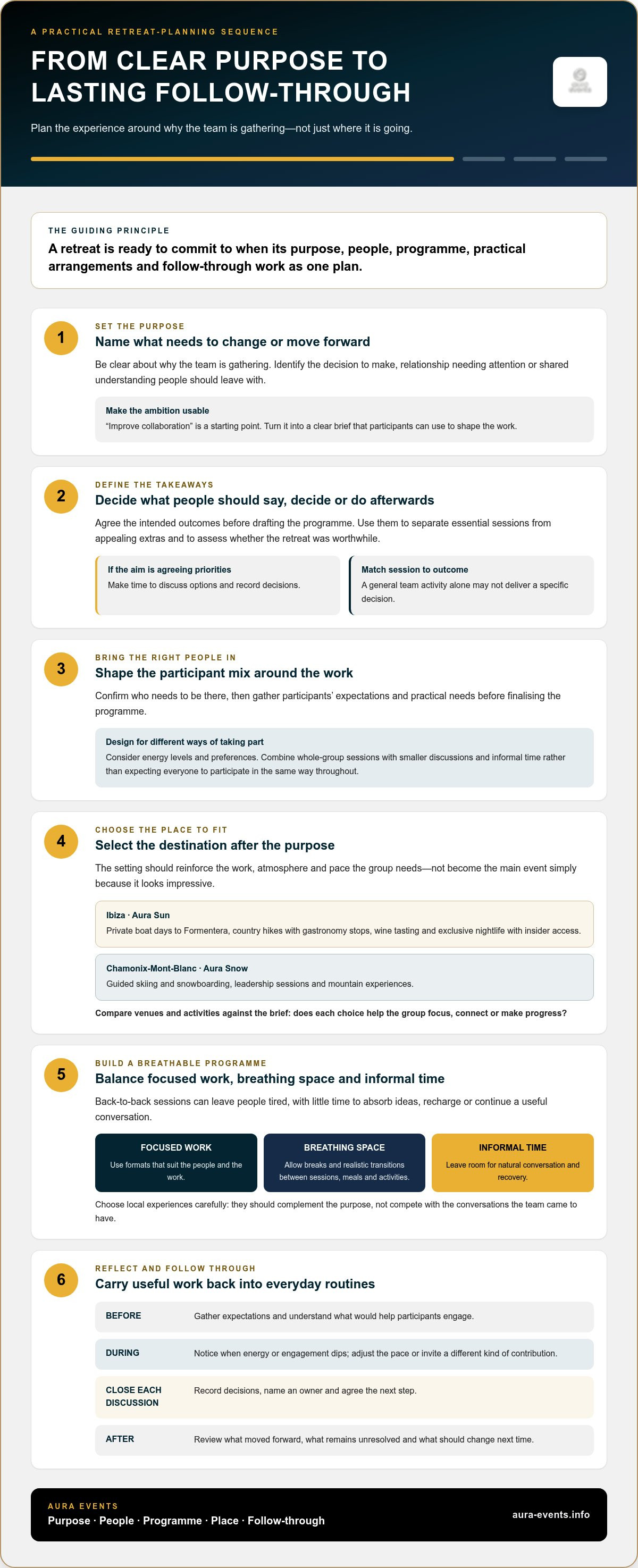
Use this corporate retreat checklist before you commit
A venue or activity can be difficult to reconsider once it’s booked. Before committing, trace the experience from the reason for gathering to what happens after everyone returns. This practical check helps reveal gaps early, including whether the travel plan, participant needs and programme fit together.
A retreat is ready to commit to when its purpose, people, programme, practical arrangements and follow-through work as one plan.
Purpose: State the intended outcomes and how you’ll recognise progress.
Participants: Confirm who needs to be there and gather relevant needs or expectations.
Programme: Check that sessions and activities support the purpose, with time for breaks and conversation.
Logistics: Map arrival times, accommodation, transfers, activity timings and transitions between locations.
Follow-through: Decide how you’ll record decisions, assign owners and review what the retreat achieved.
Check the practical details before the itinerary is final
Look at the schedule from a participant’s perspective. Does the pace allow for recovery? Do transfer times leave enough room to arrive, settle and take part without rushing? Check how accommodation, meals and activities fit together, and whether the agenda still serves the intended outcomes. For a leadership team considering the Alps, explore a leadership offsite in Chamonix as you shape the brief and destination.
Decide how you will respond when plans change
Some elements, such as outdoor activities, may depend on the weather. Identify likely points of uncertainty and agree on flexible alternatives that preserve the purpose of the session. Name who can make a timely decision, and ensure the people coordinating locally understand the plan. This won’t prevent every disruption, but it can make a change easier to handle without leaving the group unsure what happens next.
Use the checklist as a final readiness test: if a decision, handover or transition is still unclear, resolve it before committing. Aura Events provides destination management and on-the-ground coordination in Ibiza and the Alps, helping connect the brief with the practical details. Plan your corporate retreat with Aura Events. That structure is central to avoiding common corporate retreat mistakes.
Choose a retreat partner who makes the experience feel considered
A strong brief still has to work on the ground. Personal coordination and local relationships help connect the purpose of a retreat with its practical details, from the flow between activities to how a change in conditions affects the day. Founder Hayden brings 20 years of personal experience in Ibiza and the Alps, drawing on local knowledge to shape and coordinate each programme.
For example, Infinitum Media held an Ibiza event for 12 guests in 2025, and the client praised Aura Events’ handling of weather-related disruption. It’s a useful illustration of why responsive coordination matters: circumstances can change, and organisers benefit from having someone close to the details who can help adapt the plan.
Match the programme to Ibiza or Chamonix
In Ibiza, the Aura Sun programme includes hand-picked hotel or private villa accommodation, private boat days to Formentera, yacht charters, sunset dinners, wellness experiences and exclusive nightlife with insider access. In Chamonix-Mont-Blanc, the Aura Snow programme includes hand-picked hotel or private chalet accommodation, guided skiing and snowboarding, avalanche-search-and-rescue team-building, helicopter flights, husky sledging and off-piste and Vallée Blanche experiences. The right mix depends on the team’s purpose and preferences; the destination should shape the experience without taking it over. For an incentive brief, consider how high-end incentive travel trends might inform the balance of shared experiences and time together.
Make the next planning conversation straightforward
Bring three things to the discussion: the outcome you want, who will attend and the destination you’re considering. A clear starting point makes it easier to shape a programme around the people as well as the place. Aura Events designs corporate incentive travel and leadership retreats in Ibiza and Chamonix-Mont-Blanc, as well as providing destination management services for partner corporate event companies. That’s a considered next step in avoiding common corporate retreat mistakes.
Give the next step a clear purpose
The checklist is most useful when it becomes the starting point for a focused planning conversation. Consider what your team needs to carry back into its day-to-day work, then use that intention to guide the decisions still ahead. A retreat can be more than a pause from routine. Done with care, it can help shape how colleagues work together once they’re home.
Aura Events has operated under its own name for 10 years and delivered 30+ events. That experience informs a personal approach to turning a team’s brief into a retreat shaped around its people and chosen destination, without assuming every group needs the same kind of experience.
Bring your intended outcomes, participant profile and preferred destination into the next conversation. Explore a corporate retreat shaped around your business, and take the first step towards a gathering with purpose that lasts beyond the trip.
Frequently Asked Questions
Is a corporate retreat worthwhile without a packed agenda?
Yes. A retreat can be valuable without scheduling every hour. Decide which moments need the whole group’s attention, such as a leadership discussion or shared planning session, and which parts can remain flexible. This gives participants room to think between conversations and makes it easier to adapt if a discussion proves more useful than expected. A full timetable isn’t a measure of progress.
How do you measure whether a corporate retreat was successful?
Use evidence that reflects the retreat’s specific aim, rather than relying on attendance or whether people enjoyed themselves. If the group set out to clarify priorities, record which priorities were agreed; if the goal was to strengthen working relationships, ask participants afterwards what changed in how they collaborate. As part of avoiding common corporate retreat mistakes, compare feedback with the original intent and look for signs that outcomes are being used at work.
Can a corporate retreat work for a team with different interests and energy levels?
Yes, if participation doesn’t depend on everyone enjoying the same format. A programme might combine whole-group discussion with smaller conversations, so quieter participants have another way to contribute. For shared activities, explain what they involve and consider a different way to participate for someone who prefers not to take part. The aim is meaningful involvement, not identical enthusiasm for every element.
What should participants know before travelling to a corporate retreat?
Share a concise briefing that explains why the group is meeting, the shape of the days, where participants need to be and what to bring for planned activities. Include a clear way to raise practical needs privately before travel. For colleagues travelling from London, Amsterdam, Manchester, Bristol, Boston, New York, Washington or Miami, make the event’s arrival and meeting arrangements easy to find, rather than leaving details scattered across messages.



Comments