
Corporate retreat management for team activities, venues and goals
The strongest luxury retreats pair focused work with activities that help colleagues connect naturally. Corporate retreat management works best when the programme reflects a clear goal: yoga or meditation for wellbeing, a guided mountain challenge for shared problem-solving, or a cooking workshop for cultural discovery, with room to unwind between sessions. The setting should support the experience, not compete with it.
A retreat can be memorable without an overfilled schedule. Effective plans leave people time to think, talk and enjoy the destination, while keeping activities purposeful and accessible.
This guide explains how to match team activities to retreat goals, choose a venue and organise an overseas gathering. It also explores what a company retreat can achieve, from stronger working relationships to clearer priorities, and offers practical considerations for choosing a format, shaping the schedule and making the experience feel considered from arrival to departure.
Table of Contents
1. What events are easy to organise and popular for team building activities for luxury corporate retreats?
Choose activities that serve the retreat’s purpose and suit its setting. A guided walk can prompt informal conversation, while a cooking session gives colleagues a shared task. Both can work for smaller groups and sit alongside focused work sessions.
Adventure activities are most useful when each challenge connects to a leadership skill. A guided mountain route, for example, can encourage teams to communicate, assess changing conditions and make decisions together. For a high-ropes course, brief participants beforehand, offer different challenge levels and finish with a facilitated reflection. Ask what helped the group solve problems, then connect those observations to a current work challenge.
Balance structured sessions with genuine recovery time. A practical schedule can reserve 30% to 40% of active daytime hours for downtime and end presentations by 4:00 PM. Daily yoga or meditation can support a wellness-focused programme; an unhurried lunch or spa session offers a quieter alternative.
Make participation inclusive rather than treating every activity as compulsory. Offer a choice between a mountain walk and a scenic venue-based session, and explain physical demands in advance. This helps accommodate different access needs, comfort levels and working patterns.
Sustainability and community involvement can give a retreat a local purpose. A team might help plant a community garden or clean a nearby park, guided by local knowledge. A regional cooking session can offer a lower-impact way to explore local food traditions together.
Remote colleagues can still contribute to team building. Invite them to join an online strategy session, share ideas through a collaborative art brief or take part in a hybrid quiz. Give remote participants a clear role, a shared agenda and time to speak, rather than leaving them to observe.
For UK retreats, consider health and safety, accessibility and employment arrangements together. Record activity risks, provide accessible alternatives and clarify whether attendance is expected, tailoring arrangements to the format, such as an optional mountain walk or a required leadership session.
2. Exclusive-use corporate retreat venues
An exclusive-use venue gives your team privacy, shared spaces and control over the atmosphere. For mid-sized teams of 30-150 people, consider an exclusive hotel or resort buyout. Plan venue and core travel bookings 16-12 weeks before the retreat, so accommodation and transport can be coordinated around the programme.
Look beyond polished photographs. Compare bedroom layouts with the group’s needs, then check whether meeting rooms suit the planned work. A dedicated meeting room may suit presentations, while a drawing room can create a more informal setting for discussion. Consider relaxation space, dining arrangements and how easily people can move between sessions and bedrooms.
Match the destination to the retreat’s purpose. A countryside venue in the UK can offer outdoor space and a quieter pace, while a city setting may make travel and cultural visits more straightforward. Some venues are within National Parks or Areas of Outstanding Natural Beauty. Features such as a private spa, pool, sauna or hot tub can also shape downtime.
Before booking, map the day around the venue. Decide where sessions, meals and informal conversations will take place, and plan for changes in weather. Check travel access from the team’s starting points, room configurations, catering arrangements and how well the venue fits the retreat theme. These details affect both the practical flow and the sense of occasion.
For an overseas destination, weigh travel time against the experience the setting makes possible. Ibiza can suit a retreat built around coastal scenery and shared time away from the office. Explore Ibiza retreat settings as one option for an island-based programme.
3. What are the stages of planning a corporate retreat abroad?
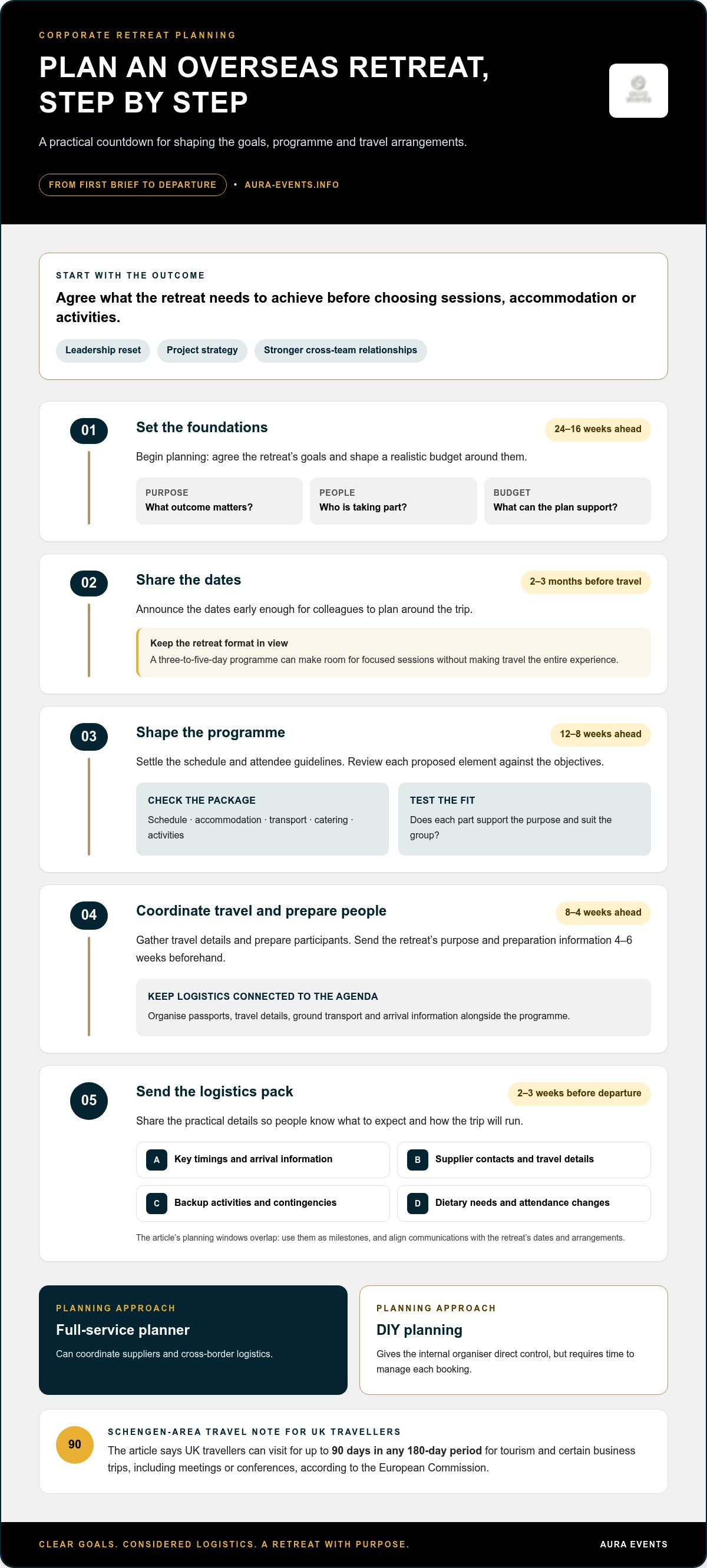
Start by agreeing the outcome: a leadership reset, project strategy or stronger cross-team relationships. Set objectives before choosing sessions, accommodation or an outdoor programme. Begin planning 24-16 weeks ahead to shape goals and budget; announce dates 2 to 3 months before travel so colleagues can plan.
Build the schedule and practical arrangements in stages. At 12-8 weeks, settle the programme and attendee guidelines; at 8-4 weeks, gather travel details and prepare participants. Send purpose and preparation information 4-6 weeks beforehand, then share the logistics pack 2-3 weeks before departure. A three-to-five-day format can allow focused sessions without making travel the entire experience.
When comparing corporate retreat management companies and packages, review the proposed schedule, accommodation, transport, catering and activities, and how each supports your objectives. A full-service planner can coordinate suppliers and cross-border logistics. DIY planning gives the internal organiser direct control, but requires time to manage each booking.
For a UK team travelling to the Schengen area, UK travellers can visit for up to 90 days in any 180-day period for tourism and certain business trips, including meetings or conferences, according to the European Commission. Organise passports, travel details, ground transport and arrival information alongside the agenda. Ask event planners to help source food, entertainment and team activities that suit the destination and the group.
Plan for risks before they become disruptions. Prepare contingencies for travel delays, poor weather during outdoor sessions, dietary needs and changes in attendance. Keep key timings, supplier contacts and backup activities in one shared document. Employers should also account for possible tax, National Insurance and reporting responsibilities on travel and subsistence spending. HMRC publishes overseas scale-rate expense guidance for employees travelling outside the UK.
4. What is the goal of a company retreat?
A retreat should translate its objectives into decisions and behaviours people can carry back to work. Within 48 hours of returning, ask attendees what helped, what felt less useful and which challenges need attention. A short survey can gather comparable responses, whilst an optional conversation gives quieter colleagues room to explain their experience.
Make feedback specific to the programme. Ask whether leadership sessions clarified priorities, whether the schedule allowed enough comfort and downtime, and whether activities felt relevant to the team’s needs. Include an open question about what participants would change next time. Responses can show which sessions created shared understanding and which formats need a different approach.
Close the loop promptly. Send a recap within two days, recording key decisions, owners and next steps. A 48-hour follow-up email can restate commitments while details remain fresh. For example, if a group agreed to improve project handovers, name the action owner and the first practical change rather than leaving the idea as a general ambition.
Build accountability beyond the return journey. Set a 90-day execution commitment, then test one improvement within 30 days. A 30-day progress update can surface obstacles early; a 90-day recalibration discussion can assess what changed and what needs adjusting. Compare those results with the retreat’s original objectives, not simply whether attendees enjoyed the setting.
Use each retreat’s feedback to improve the next one. Group responses by themes such as session relevance, travel, accommodation and accessibility, then compare patterns across events. If attendees valued smaller workshops but found a packed agenda tiring, protect discussion time and revise the schedule. This makes employee feedback a practical design tool, not a post-event formality.
Ready to shape a retreat around meaningful objectives and follow-through? Plan your next retreat with a clear purpose and a programme built to support it.
Aura Events: Ibiza Corporate Retreats
Aura Events plans and manages Ibiza corporate retreats for teams seeking a distinctive setting for focused work and shared experiences. Luxury Villa and Chalet Sourcing helps shape the stay around the retreat’s purpose, while Private Yacht Charters can offer a different perspective on the island. For leadership teams drawn to the mountains, Chamonix Leadership Offsites provide an alpine alternative.
Turn to Aura Events when you want the setting, accommodation and programme to feel coherent rather than assembled from disconnected pieces. Start by sharing your goals and preferred destination to shape the retreat.
Give the retreat a future beyond the departure
A valuable next step is to decide who will carry the retreat’s intentions into everyday work. Before confirming a programme, identify the person responsible for each priority and how colleagues will see progress. That ownership helps corporate retreat management connect an inspiring experience with how your team works afterwards.
Aura Events offers Ibiza Corporate Retreats, Chamonix Leadership Offsites and Luxury Villa and Chalet Sourcing. These can help shape a setting around the atmosphere and purpose you want your team to share, whether that means an island backdrop or mountain surroundings for leadership conversations.
Begin with the change you want to make, then let that guide the retreat’s character. Contact Aura Events to plan your retreat and take the next step towards an experience with purpose.
Frequently Asked Questions
What events are easy to organise and popular for team building activities for luxury corporate retreats?
Leadership, creative and culinary sessions can be shaped around your team’s objectives. A negotiation workshop, for example, gives colleagues a practical scenario to solve together, while a regional cooking session creates a relaxed shared task. Choose activities with different ways to participate, so colleagues can contribute comfortably without needing the same skills or confidence.
Do the corporate retreat venues have meeting spaces?
Meeting spaces vary in layout and facilities. Match the room to the planned work: a boardroom arrangement may suit confidential discussions, while flexible seating can support collaborative workshops. Ask for a floor plan and confirm the availability of presentation equipment, connectivity, natural light and sound privacy for your sessions.
What are the best international locations for a corporate retreat?
The best location depends on the experience your team needs. Ibiza offers a coastal atmosphere and opportunities for shared experiences; Chamonix-Mont-Blanc provides an alpine backdrop for leadership gatherings. For teams travelling from London, Manchester, Bristol, Amsterdam or cities on the US East Coast, weigh the destination’s character against travel connections, the programme and time away. The setting should reinforce the retreat’s purpose, not distract from it.
What are the stages of planning a corporate retreat abroad?
Plan in sequence: define the intended outcomes, choose a destination and dates, then coordinate accommodation, transport, meals and activities. Gather attendee details that affect arrangements, such as dietary needs and accessibility requirements. Give participants clear travel information and a named point of contact. UK teams visiting the Schengen area should understand the applicable entry conditions before finalising travel plans.
What is the best month for retreats?
Spring, from March to May, and autumn, from September to October, are common periods to consider for company retreats. The right month depends on the destination, activities and colleagues’ work commitments. For an outdoor programme, align dates with the setting and build flexibility into the schedule. For a strategy-focused retreat, prioritise attendance and a quieter period in your organisation’s calendar.
What is the cancellation policy?
Cancellation terms depend on the booking agreement, so review them before committing to a venue or travel arrangements. Check the deadlines and consequences for cancelling, changing dates or reducing attendee numbers, and note whether suppliers have separate terms. Set an internal decision date for confirming attendance, then keep a record of the agreed terms and any later changes.



Comments