
Luxury Corporate Incentive Travel: 2026 Benchmarking Guide
The most impressive destination can still make the wrong incentive. With luxury corporate incentive travel, a striking setting matters, but it cannot show on its own whether a programme serves your business or feels meaningful to the people invited.
To judge whether an experience is worth considering, weigh its purpose, participant value, destination fit and delivery against the same clear criteria. This guide offers a practical framework for comparing options, shaping an experience around your organisation’s objectives and participants, and asking potential planning partners the right questions.
We’ll explore how to assess programme design, balance shared experiences with time to unwind, and evaluate the role of local knowledge. From Ibiza’s coast to Chamonix’s mountain setting, the details should support the reason for bringing people together, not simply provide a beautiful backdrop. Use the guidance to compare premium programmes and understand what expert planning can contribute.
Table of Contents
What should luxury corporate incentive travel benchmarks actually measure?
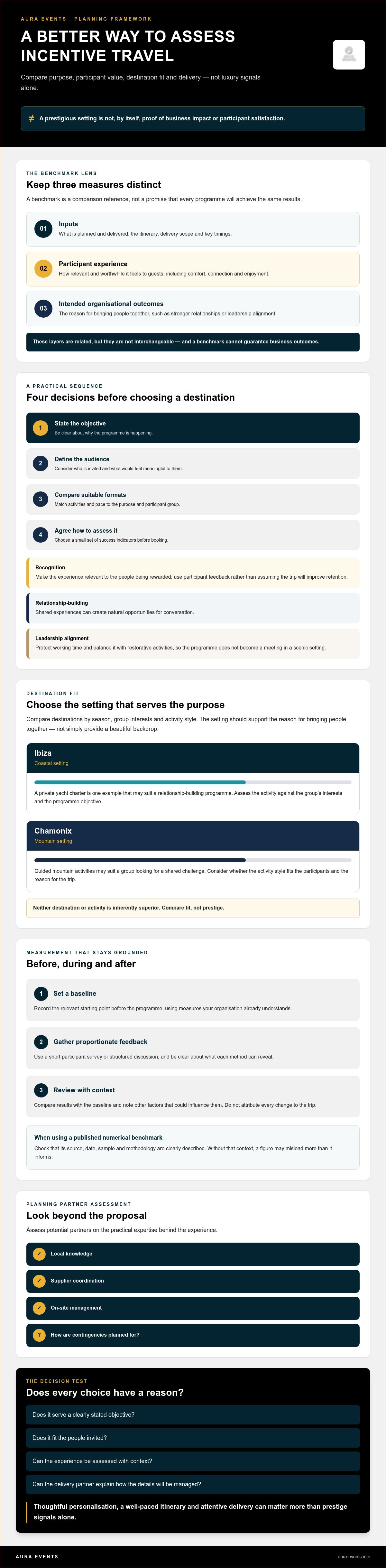
A benchmark is a comparison reference, not a promise that every programme will achieve the same results. For luxury corporate incentive travel, it helps you assess whether a proposed experience fits its purpose and audience, and how its design and delivery compare with alternatives. It cannot guarantee business outcomes.
Incentive travel describes travel used to recognise or motivate people. When evaluating a programme, separate three layers: inputs, such as the itinerary and delivery scope; participant experience, including perceived relevance and enjoyment; and intended organisational outcomes, such as stronger relationships or leadership alignment. These layers are related, but they are not interchangeable.
Which measures make a programme comparable?
Start with objective clarity, audience fit, itinerary relevance and delivery scope. Compare each option against the same objective, participant group and measurement approach. A recognition trip and a leadership offsite serve different purposes, so a fair comparison needs to account for that difference.
Operational indicators can show whether planned activities took place and key timings were met. Participant feedback captures perceptions such as comfort, connection and whether the experience felt worthwhile. Keep these measures distinct. If you use a published numerical benchmark, check that its source, date, sample and methodology are clearly described. Without that context, a figure may mislead more than it informs.
Why luxury alone is not a useful benchmark
A prestigious venue or private yacht may make a strong first impression, but neither proves business impact or participant satisfaction. The more useful question is whether each choice serves the programme’s purpose and feels considered for its guests.
For example, a private yacht charter may suit a relationship-building programme, whilst guided mountain activities could better match a group looking for a shared challenge. Neither is inherently superior. Thoughtful personalisation, a well-paced itinerary and attentive delivery can matter more than prestige signals alone. Compare the experience people are being invited into, not simply the luxury features listed in a proposal.
How to evaluate incentive travel against business objectives
A useful evaluation starts before you choose a destination. For luxury corporate incentive travel, work through four decisions: state the objective, define the audience, compare suitable formats, then agree how you’ll assess the experience. This keeps an appealing itinerary connected to a clear business reason.
Match measures to the purpose of the trip
Different aims call for different designs. Recognition should feel relevant to the people being rewarded, so use participant feedback rather than assuming a trip will improve retention. Relationship-building may benefit from shared experiences that create natural opportunities for conversation. Leadership alignment needs protected working time, balanced with restorative activities, so the programme does not become a meeting in a scenic setting.
Participant research can help frame your questions, but it should not dictate the answer. The Incentive Research Foundation’s study of attendee travel preferences offers a reference point. Test its findings against your own audience, destination and purpose. For further context on evolving experience choices, explore high-end incentive travel trends.
What to evaluate before and after the experience
Before booking, record the intended audience, objective, practical constraints and a small set of success indicators. If the aim is stronger cross-team relationships, decide what evidence would reasonably suggest greater connection. Avoid relying on a broad claim of improved collaboration without agreeing how you would recognise it.
Set a baseline: record the relevant starting point before the programme, using measures your organisation already understands.
Choose proportionate feedback: use a short participant survey or structured discussion, and be clear about what each method can reveal.
Review with context: compare results with the baseline and note factors that could influence them. Do not attribute every change to the trip.
Use consistent definitions and questions when comparing options, then revisit the agreed indicators afterwards. Organisations considering a bespoke programme can explore Aura Events’ corporate retreats as a planning option.
How Ibiza and Chamonix compare as incentive travel destinations
Ibiza and Chamonix offer different settings, not a universal ranking. The right fit depends on the season, group interests and purpose of your luxury corporate incentive travel programme. Use this comparison to narrow your choice, then confirm current venue and activity availability for your dates.
Check the practical fit
In Ibiza, check that the venue, travel arrangements and planned activities suit the group and dates. Consider how the schedule will balance shared experiences with time to relax. For destination-specific ideas, read this guide to Ibiza corporate retreat planning.
In Chamonix, consider participant ability, relevant safety requirements and suitable alternatives for those who do not wish to ski. Check transport logistics, seasonal conditions and activity suitability, then agree contingency options in case weather affects the plan. Explore Chamonix leadership offsite guidance for further destination context.
Choosing between these settings? Discuss a destination-led corporate programme with Aura Events.
How to compare luxury incentive travel partners and take the next step
A polished proposal is only the beginning. For luxury corporate incentive travel, assess how a prospective partner turns your brief into destination choices, participant experiences and reliable delivery. Local knowledge matters, as does a clear account of who is responsible for each part of the programme.
Questions to ask a prospective agency
Local knowledge: How does your understanding of the destination shape venue and activity recommendations?
Programme design: How do the itinerary and proposed experiences respond to our objectives and participants’ needs?
Coordination: Who leads planning and coordinates suppliers, transport and other agreed elements?
On-site delivery: What support is provided during the programme, and who is the point of contact?
Contingencies: How would you approach changes, accessibility needs or disruption to planned activities?
Look for specific, considered answers rather than broad assurances. A partner with local expertise in Ibiza and Chamonix, for example, should be able to explain how the setting informs the proposed itinerary and identify details that still need confirmation.
Turn benchmarks into a clear decision
Before planning begins, agree the scope, responsibilities and evaluation measures. This helps prevent assumptions about what is included or how success will be reviewed. Score each proposal against the same criteria, such as objective fit, participant relevance, local knowledge, supplier coordination and on-site management.
Record trade-offs and details still to be verified, including venue or activity availability. Do not let presentation quality or prestige outweigh fit. The strongest option is the one that best answers your brief, not the one that would top a generic ranking.
Ready to explore a programme shaped around your objectives and destination? Discuss a bespoke incentive itinerary with Aura Events.
Make your next programme a considered choice
The strongest luxury corporate incentive travel programme is not simply the most prestigious. It connects a clear business purpose with an experience suited to its participants, then delivers it with care. Compare proposals against consistent criteria, agree how you’ll assess the experience and choose a destination for its fit, not its status alone.
Look beyond the itinerary to the expertise behind it. Aura Events brings over twenty years of experience in luxury travel and event management, with local knowledge of Ibiza and Chamonix-Mont-Blanc. Its end-to-end planning, supplier coordination and on-site management can help turn a considered brief into a coherent programme, with responsibilities established from the outset.
If you’re ready to explore an experience shaped around your organisation’s objectives and people, discuss a bespoke incentive travel programme. A conversation can help you move from broad comparisons to a destination and itinerary with purpose. Contact Aura Events to discuss your corporate retreat or incentive programme.
Frequently Asked Questions
What are incentive travel benchmarks?
Incentive travel benchmarks are comparison references for assessing programmes, not promises of universal results. They help organisations compare elements such as objective fit, participant experience and delivery scope, provided the options are assessed on consistent terms. Treat any published numerical benchmark carefully: check who produced it, when, which participants were included and how the figures were gathered before applying it to your own programme.
How do you measure the success of a corporate incentive trip?
Measure success against the purpose agreed before the trip, rather than relying on a single general impression. Record a baseline, choose relevant indicators and gather proportionate participant feedback afterwards. For a recognition programme, responses can show whether the experience felt valuable; for relationship-building, assess whether participants report useful opportunities to connect. Review results in context, as feedback alone cannot establish that travel caused a business outcome.
What should companies compare when choosing an incentive travel agency?
Compare destination knowledge, bespoke programme design, supplier coordination, delivery responsibilities and on-site management. Ask how each proposal reflects your objectives, audience and practical needs, and how changes or contingencies would be handled. If attendees are travelling from London, Manchester, Bristol, Amsterdam, Boston, New York, Washington or Miami, clarify how their different starting points will be considered in travel arrangements. Agree scope and evaluation measures before planning begins.
Is luxury corporate incentive travel suitable for a small team?
It can be suitable if the experience, setting and delivery scope are proportionate to the team and its purpose. A smaller group may value a tailored itinerary, time for conversation or a shared activity, but size alone does not determine fit. Consider the group’s interests, accessibility needs and preferred pace, then check that the proposed villa, chalet or activities can support the experience you intend to create.
How do you choose between Ibiza and Chamonix for a corporate incentive trip?
Choose according to the programme’s purpose, season and participants, not a universal ranking. Ibiza may suit a coastal itinerary shaped around a villa stay, private yacht charter or wellness. Chamonix offers an alpine setting, with chalet stays and guided mountain activities to consider. Check activity availability, participant suitability, travel arrangements and contingency options for your dates before deciding.



Comments